
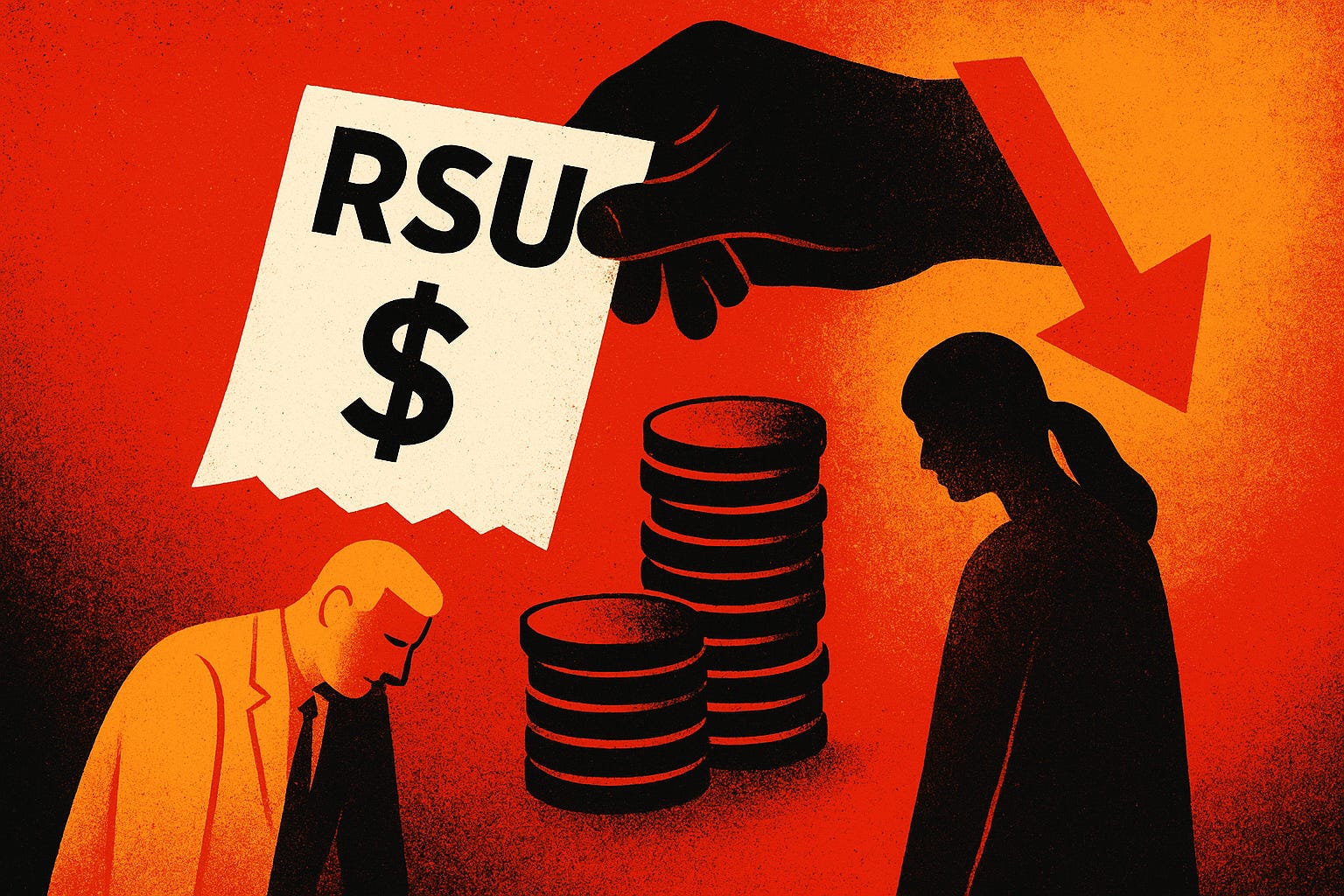
RSUs at Klarna might sound exciting—ownership in a fast-growing scale-up, a chance to make bank. But the reality for employees? You could lose hundreds of thousands of SEK in lost salary, missed pension contributions, and taxes on illiquid stock. Meanwhile, Klarna saves tens, or even hundreds, of millions every year in reduced payroll costs.
Let’s dig in…
Why RSUs Can Hurt Employees
TLDR: RSUs are taxed twice in Sweden. At vesting, you pay income tax on stock you can’t sell, and when you eventually sell, you pay capital gains tax on any increase. If the company is private (like Klarna in 2020), you can’t just liquidate, so you’re paying real taxes on “paper money.”
All financial instruments—RSUs, stock options, warrants, QESO—are a gamble. Sometimes you win big. Sometimes you pay more in taxes than the stock is worth. RSUs in privately held companies tend to be the latter.
Double-trigger taxation: Income tax at vesting + capital gains tax at sale.
Illiquidity: You can’t sell until a company IPO or a selling window.
Reduced pensionable salary: Any part of your pay converted to RSUs reduces your occupational pension (tjänstepension, TJP) contributions.
Unfamiliar with RSUs? Check out my explanatory blog post before reading any further.
How TJP Works in Sweden
TLDR: Salary up to 7.5 × IBB generates 4.5% deposits to your pension. Anything above that generates 30%. If RSUs replace salary, your pension deposits shrink immediately.
Reducing pensionable salary in favor of receiving RSUs is generally a risky move for employees. To understand why, it’s important to first understand how occupational pensions (🇸🇪 tjänstepension, or TJP) work in Sweden. These pensions, governed by collective bargaining agreements, provide a guaranteed and long-term retirement benefit. Sacrificing pensionable salary can significantly reduce future retirement income, while RSUs carry market risk and no guaranteed return, making this trade-off potentially costly in the long run.
Here’s the exact formula for those who want the details—don’t worry, we’ll break it down in plain language right after.
where
C = Total pension contribution (🇸🇪 pensionsavsättning)
S = Annual pensionable1 salary (🇸🇪 pensionsgrundande årslön)
B = Income base amount, IBB (🇸🇪 inkomstbasbelopp)
Or in layman’s terms: any salary up until 7.5x IBB generates a 4.5% deposit to your TJP by your employer (in addition to your salary). And anything above that generates a 30% deposit on the excess amount.
However, do note the important word pensionable. Now you might think that because you’re paying income tax on vested RSUs that would count towards your pensionable income? If so, you’d be wrong. Meaning any reduction in pensionable salary in favour of RSUs would also mean a reduction in TJP.
Jane Doe gets her raise in RSUs
TLDR: Jane was promised a 5% raise in RSUs (2,500 SEK/month). After 4 years, she’s down ~175,000 SEK in lost salary, pension, and taxes. Why? Cliff vesting, FMV fluctuations, and double taxation.
Ok, now that we’ve further familiarised ourselves with RSU programs and how TJP deposits work, let’s look at some examples. We’ll do all the math as if it’s 2020 since that was the start of the Klarna RSU program.
Meet Jane Doe. She works as a software developer and her monthly salary is 50.000 SEK. That means her employer sets aside 4.354 SEK monthly to her TJP2
Mind you! This is only guaranteed if her employer has a collective bargaining agreement (🇸🇪 kollektivavtal). Without it there’s nothing forcing them to make the deposits (which usually means they don’t). So read those employment contracts thoroughly folx!
Now, let’s look at how Jane Doe’s financial situation changes if she was given her yearly raise solely in RSUs. Let’s say her employer (to sweeten the deal) offered Jane Doe the equivalent of a 5% raise in RSUs, that’s 2.500 SEK monthly.
Since Jane’s pensionable salary won’t increase3, she’s now losing out on 9.000 SEK4 in TJP deposits yearly. That’s a loss in potential pension deposits of 17.2%, caused by a mere 5% raise swapped to RSUs. Not to mention the 30.000 SEK5 in gross salary she’s missing out on.
Jane gets her first RSU grant
So Jane Doe’s initial RSU grant will be worth 30.000 SEK, which at the time of the grant corresponds to 682 RSUs at a FMV of 44 SEK6. After 1 year 25% of this will vest (cliff vest) and after that the remainder will vest quarterly. In other words, it’ll take her 4 years to “earn” back what would’ve been hers in salary year 1.
Year 1 – Cliff Vesting Hits
TLDR: Jane’s 30,000 SEK RSU grant grows to 54,000 SEK after 1 year (FMV 44 → 80 SEK). She pays 7,493 SEK in taxes on illiquid stock. Cliff vesting and private company restrictions mean she can’t cash out immediately.
So the first cliff vest rolls around, and now the FMV has risen from 44 SEK to 80 SEK (an 81% increase), so the 30,000 SEK grant is now worth 54,000 SEK. And the vested value is 13.500 SEK7. For Jane Doe, that means paying an extra 7.493 SEK8 in income tax on her illiquid assets (vested RSUs).
At this point Jane Doe has missed out on 46.493 SEK9 (gross) in lowered pension deposits, reduced salary and RSU tax combined. Meaning if she were able to sell the vested RSUs on the spot (which she couldn’t), she still would’ve lost 36.143 SEK on the deal10, despite the RSUs actually having almost doubled in value.
Year 2 - FMV explosion
TLDR: FMV skyrockets to 315 SEK. 25% vesting means Jane pays 29,895 SEK in taxes that year on illiquid stock. Total cumulative loss now ~115.479 SEK.
Another year passes, and the FMV has surged to 315 SEK11 — a 294% increase, nearly quadrupling in value. Jane Doe’s vested RSUs are now worth 53.865 SEK12 , but she owes 29,895 SEK in income tax on these illiquid shares13.
After two years in the program, her cumulative losses total 115.479 SEK14, and even at this peak FMV, her vested RSUs fall short by 36.053 SEK15.
Now, imagine this effect compounding over the following years. Let’s break down the numbers.
Year 3 & 4 - FMV collapse
TLDR: FMV plummets to 44 SEK. Jane’s RSUs are now worth 30,096 SEK. Total 4-year loss in salary, pension, and taxes: ~201,715 SEK. Net loss after selling RSUs: ~178,819 SEK.
The last 2 years of Jane Doe’s RSUs program the FMV plummets to 44 SEK. This means her combined income tax year 3 and 4 amounts to 8.327 SEK16.
So after 4 years Jane Doe has lost 201.715 SEK17 in gross salary, TJP deposits, and RSU income tax combined.
And now with the FMV drop of 85% from the peak, her 682 vested RSUs are worth a measly 30.096 SEK18. Meaning she’s lost 171.619 SEK19 over the span of the RSU program.
And that’s not even counting the potential increase in value those TJP could’ve had over the years. If we take into account a standard YoY increase of 6% we’re looking at 205.086 SEK20 in total losses.
So after selling all her vested stock she ends up having lost 174.990 SEK over the course of the 4 year RSU program21.
Note: the RSU program at Klarna was “rolling”, meaning employees received grants yearly. The calculations above is for 1 grant in 2020 with a 4 year vesting period. To get the full picture you’d have to do the same calculations above for each grant over the time period 2020 - 2025.
Withhold-to-Cover: Less Pain, Same Risk
TLDR: Withhold-to-cover would have eased the cash pinch, but Jane still loses big.
If Jane Doe had been able to use a “withhold to cover” mechanism, the income tax on her vested RSUs would have been automatically deducted from the grant rather than paid out of pocket. In Year 1, this would have covered 7.588 SEK on her 13.680 SEK vested RSUs. In Year 2, 29.891 SEK would have been withheld, and in Years 3 and 4, another 8.327 SEK. That means her total cumulative loss drops from 201.715 SEK to roughly 155.909 SEK. Net loss after selling the RSUs falls from 171.619 SEK to around 126.000 SEK.
The takeaway? “Withhold to cover” would have taken the sting out of taxes on illiquid stock, but the real hit—lost pension contributions (9,000 SEK/year) and foregone salary (30,000 SEK/year)—remains. RSUs still end up being a risky trade-off compared with a straight salary increase.
Company Perspective: Klarna Saves Millions
TLDR: By forcing RSUs instead of salary raises, Klarna saved ~188 million SEK over 4 years, while employees like Jane lost ~201,715 SEK.
Meanwhile, the employer has reduced their payroll cost by millions yearly. Let’s run the math for the Klarna example.
In 2020 Klarna had roughly 7000 employees. Not all were eligible for the RSU programs. So let’s say about 60% were. Then let’s further assume the average RSU to cash salary split was 5% to 95%, and that the average salary at the time was 45.000 SEK. That landed Klarna an annual saving of 13 million SEK just in payroll22.
But it doesn’t stop there. Now let’s add the reduction in TJP deposits too. Avoiding to increase employees’ pensionable salary from 45.000 to 47.250 SEK meant a yearly cost reduction for Klarna by 8.100 SEK per employee23 in 2020. In other words, Klarna saved 34 millions yearly on reduced pension deposits24.
This accumulates to a total of 188 million SEK25 in savings over the same period an average employee lost approx 201.715 SEK26.
Making it make sense
At the end of the day, RSUs in a private company like Klarna weren’t about “democratizing ownership.” They were about transferring risk from the company to its employees, while simultaneously cutting payroll and pension costs on the backs of workers.
For employees, the outcome was devastating: tens or even hundreds of thousands of SEK lost in salary, pension contributions, and taxes — all for illiquid stock that, in many cases, couldn’t even be sold when it mattered.
For Klarna, the outcome was brilliant: hundreds of millions saved in payroll and pension obligations.
So when we ask who really benefited from Klarna’s RSU program, the math leaves no room for doubt. It wasn’t the employees.
The part of one’s salary used by the employer to calculate the TJP deposits.
4.5% * (7.5 * IBB) + 30% * (600.000 - 7.5 * IBB) = 52.245 SEK, 4.354 SEK monthly.
IBB in 2020 was 66.800 SEK.
Although taxed as income, RSUs are not pensionable.
Since the 2500 SEK raise is above 7.5 IBB, the additional pension deposit would have been 750 SEK per month, ie 9000 SEK yearly.
A monthly missed income increase of 2.500 SEK accumulates to 30.000 SEK yearly.
These are the exact FMV numbers from the Klarna RSU program in 2020.
FMV rising from 44 to 80 SEK corresponds to a 81% value increase. Meaning the entire grant is now valued at 54.000 SEK. A quarter of that is 13.500 SEK.
Jane Doe’s annual salary is 600.000 SEK, that means her income tax is 29,82% (2020). But the vested RSU are taxed according to marginal tax (55,5%) which corresponds to 7.493 SEK at a cliff vest value of 13.500 SEK.
9000 SEK in pension deposits + 30.000 SEK in gross salary + 7.493 SEK paid in RSU tax = 46.493 SEK in losses year 1
RSU capital gains tax would’ve been (13.500 - 9.000) * 30% = 1.350 SEK. So she would’ve gained 12.150 SEK after taxation. But she’s missed out on 48.293 SEK because of the RSUs, so she’s still actually losing 36.143 SEK.
Klarna’s FMV per RSU in Jan 2022.
25% of 682 RSUs = 171 units * 315 = 53.865 SEK in theoretical vested RSUs
53.865 SEK * 55,5% marginal tax = 29.895 SEK
Year 1: 46.493 SEK. Year 2: 9000 + 30.000 + 29.895 = 68.895 SEK. Bringing the total loss to 115.388 SEK.
The original grant was 682 RSUs at 44 SEK. After 2 years 341 have vested, now at a FMV of 315 SEK = 107.415 SEK. Hence they’re theoretically worth 107.415 SEK. And after capital gains tax (if she could sell) she’d be left with 79.335 SEK.
107.415 - (107.415 - (44 SEK * 314) ) * 30% = 79.335 SEK.
115.388 SEK - 79.335 SEK = 36.053 SEK
341 RSUs valued at 44 SEK amounts to 15.004 SEK and the 55,5% marginal tax would be 8.327 SEK.
4 years of losing TJP and gross income amounts to 4 * 39.000 = 156.000 SEK. Her RSU tax during this time amounts to 7.493 + 29.895 + 8.327 = 45.715 SEK. So her total loss during these 4 years accumulates to 201.715 SEK.
682 RSUs * 44 SEK in FMV = 30.096 SEK
201.715 SEK in losses - 30.096 in RSU value = 171.619 SEK
A 6% YoY value increase for the 9000 SEK in TJP results in a total value of 39.371 SEK after 4 years. Bringing the total to: 39.371 + (4 * 30.000 SEK in gross salary) + 45.715 SEK in RSU tax = 205.086 SEK
205.086 SEK in losses - 30.096 SEK in RSU value = 174.990 SEK in losses
That means payroll cost for Klarna was approx 59.139 SEK (employee cost incl employer fees) * 4.200 = 248 million SEK for the 60% enrolled in the RSU program. Had salaries increased by 5% in 2020 that would’ve brought payroll cost up to 62.096 SEK * 4.200 = 261 million SEK. So by forcing RSUs instead they saved 13 million SEK.
45.000 SEK corresponds to 2.853 SEK in TJP deposits, and 47.250 SEK corresponds to 3.529 SEK. So the yearly employee cost reduction becomes 12 * (3.529 - 2.853) = 8.100 SEK
8.100 SEK per employee * 4.200 employees = 34 million SEK
Payroll savings were 13 million yearly, pension reductions 34 million yearly. That gives us a total of 4 * (13 + 34) = 188 million SEK
(4 * 9000 SEK in TJP) + (4 * 30.000 SEK in gross salary) + 45.715 SEK in RSU tax = 201.715 SEK